
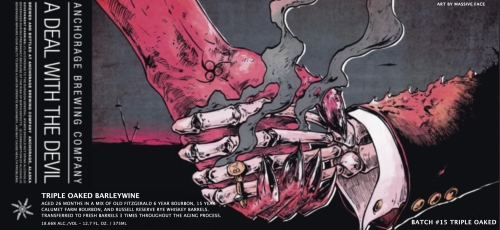
An American Barleywine pushed to the edge of oak
“The expectation is dark caramel, dense honey, bourbon vanilla, toasted oak, bitter cocoa, dried fruit, rye spices, and evident alcoholic warmth.”
In practice, this is a beer about concentration and wood management: less a “sweet and strong” Barleywine than an exercise in how alcohol, caramel, noble oxidation, and barrel can compete for space without losing structure.
Sobre a cerveja
Confirmed by the data provided: this is Batch #15, 2024 edition, within the A Deal With the Devil line, classified as Barleywine - American. It is also confirmed that the brewery is located in Anchorage, Alaska, and that Anchorage Brewing Company, founded by Gabe Fletcher, is associated with fermentation and barrel-maturation work, including the use of Brettanomyces and acid cultures in other beers in its portfolio. Here, however, there is no confirmed data on Brettanomyces, acid culture, specific malts, hops, or adjuncts; therefore, those points should not be presumed.
Technically, an American Barleywine usually works with high density, an intense malt base, enough bitterness to support the sweetness, and aging potential. In a version at 18.66% ABV with a long stay in barrel, it is reasonable to expect greater body weight, alcoholic warmth, notes of caramelization, dried fruit, and wood-derived components — such as vanilla, tannin, coconut, toast, and spices — but the presence and exact intensity of these elements depend on the recipe, fermentation, barrels, and final blend.
The reported public score of 4.72 on Untappd, based on 858 ratings, should be read only as a reception metric among users, not as technical proof of quality. What makes this beer editorially relevant lies in its confirmed parameters: extreme strength, prolonged maturation, and successive use of fresh barrels, a combination that increases both sensory potential and the risk of excess.
Origem & processo
A Deal With the Devil - Triple Oaked Batch 15 is a beer from Anchorage Brewing Company, in Anchorage, Alaska, United States. Confirmed by the data: the brewery was founded by Gabe Fletcher and is known for work with barrels, Brettanomyces, and acid cultures in other lines. For this specific beer, what is confirmed is the Barleywine - American style, Batch #15, the year 2024, the 18.66% ABV, and 26 months of maturation in bourbon and rye whiskey barrels.
Confirmed: the beer was matured for 26 months in a blend of Old Fitzgerald 6 year bourbon, Calumet Farm 15 year bourbon, and Russell Reserve rye whiskey barrels. It is also confirmed that it was transferred into fresh barrels three times during aging. Technical interpretation: transferring a high-density beer into fresh barrels tends to renew the extraction of wood and spirit compounds, rather than allowing maturation to stabilize in a single exhausted barrel. Likely sensory expectation: this may amplify vanilla, toasted oak, tannins, spices, bourbon’s aromatic sweetness, and a more evident alcoholic sensation. There is no confirmed data on malts, hops, yeast, adjuncts, extended boil, or fermentation method; any reading of those elements would be inference, not a declared fact.
Os barris
Blending & cuvée
Perfil sensorial
Based on the perceived flavors provided and the technique involved, the aromatic expectation revolves around bourbon vanilla, roasted oak, dark honey, burnt caramel, bitter cocoa, dried fruits, spices from the rye whiskey, and a possible trace of leather. The term leather appears in the perception data, not as an official description confirmed by the brewery.
It should move through deep malty sweetness, dark caramel, molasses, bourbon notes, and toasted wood, with bitterness and tannin likely serving a supporting role. Given the 18.66% ABV, it is reasonable to expect perceptible alcohol, closer to liqueur-like warmth than lightness.
Technically, a Barleywine at this strength tends to show full body, moderate to high viscosity, and a warming sensation. Long barrel maturation may bring tannic dryness, helping organize the density.
The expectation is a long, warm, woody, and lightly bitter finish, with persistence of toasted oak, bitter cocoa, burnt caramel, spices, and alcohol. If well integrated, the wood should extend the finish without erasing it with astringency.
Como beber
Suggested range by technical interpretation: very alcoholic and barrel-aged beers usually show better integration of malt, spirit, and wood when served less cold, but still below Brazilian room temperature.
Antes de abrir: Keep the bottle upright for a few hours before service and open it without rushing. In dense, matured beers, this helps reduce disturbance of any sediment and favors a cleaner pour.
No copo: It should evolve well over 20 to 40 minutes, with alcohol and wood opening gradually. Serving a small pour at a time helps follow that change.
Evolução no copo
- 0–5 minMore closed and dense; the likely perception is of dark caramel, toasted wood, and alcoholic warmth still held in a compact form.
- 5–15 minThe tendency is for bourbon vanilla, dark honey, and dried fruits to appear more clearly, while the alcohol begins to integrate with the malty sweetness.
- 15–30 minThe wood may gain definition: toasted oak, bitter cocoa, rye spices, and tannins tend to balance the density.
- 30 min or moreA more oxidative and contemplative reading may emerge, with dried fruits, leather, and burnt caramel. If it warms too much, the risk is that alcohol becomes dominant.
Harmonização
-
Medium-intensity blue cheese — Salt and fat contrast with the malty sweetness, while the cheese’s intensity matches the alcoholic weight and the wood.
-
Milk pudding with a very dark caramel sauce — The caramelized sauce resonates with burnt caramel and bourbon vanilla, without demanding high acidity from the beer.
-
Dark chocolate brownie without excess sugar — Bitter cocoa reinforces the dark chocolate impression and helps restrain the sense of sweetness.
-
Slow-roasted beef rib — The fat and caramelization of the meat find a counterpoint in alcohol, wood tannin, and spices from the rye whiskey.
-
Walnut tart or pecan pie in a small portion — Nuts, caramel, and buttery pastry follow the Barleywine’s density; the portion should be moderate to avoid adding excessive sweetness.
Para quem é
- those who appreciate high-intensity American Barleywine
- those seeking bourbon barrel-aged beers with a clear wood presence
- drinkers accustomed to Imperial Stout and Barleywine above 14% ABV
- those who enjoy profiles with dark caramel, vanilla, dried fruit, cocoa, and alcoholic warmth
- people who prefer slow tasting in small pours
- those looking for light, dry, and refreshing beers
- those bothered by apparent alcohol
- those who avoid intense malty sweetness
- those who prefer a discreet barrel presence or a lightly wooded profile
- those expecting high drinkability in volume
Guarda
Com o tempo: From a technical interpretation, cellaring may round out the alcohol, integrate the wood, and shift the profile toward dried fruit, honey, dark caramel, leather, and oxidative notes. This does not mean guaranteed improvement; it means change.
Atenção: Over time, it may lose vibrancy, increase oxidative perception, become overly dry from the wood, or make the alcohol more evident if the structure does not keep pace.
Armazenamento: Upright, protected from light, at a cool and stable temperature, ideally below 18 °C.
Riscos de execução
- Aggressive alcohol — In high-ABV beers, prolonged maturation can help integration, but it does not eliminate warmth. Proper serving temperature and time in the glass are decisive in reducing perceived harshness.
- Excessive sweetness — The style accommodates high malt density; rye whiskey barrels, oak tannins, and structural bitterness tend to act as counterweights, although there is no confirmed IBU data.
- Dominant barrel — Three transfers into fresh barrels increase extraction and, therefore, the risk of excessive wood. Likely control depends on time, barrel selection, and composition among components.
- Heavy oxidation — Barleywines tolerate and sometimes benefit from noble oxidative notes, such as dried fruit and dark honey. The risk is moving into cardboard, tired sherry, or overly dry wood; cool, dark storage reduces that possibility.
- Lack of integration between beer and spirit — The 26-month maturation tends to favor integration, but sequential fresh barrels can renew the presence of spirit. The best reading happens when bourbon, rye, malt, and alcohol feel like layers of the same whole.
Se você conhece…
- American Barleywine— It shares the logic of high density, intense malt, and support from bitterness; it differs by pushing the format to the extreme, with 18.66% ABV and long maturation in spirit barrels.
- English Barleywine— It may find common ground in dried fruit, caramel, and noble oxidation, but tends to be more alcoholic, more marked by American barrel character, and less centered on classic English malt elegance.
- bourbon-aged Imperial Stout— It shares the vocabulary of vanilla, oak, cocoa, and spirit, but without necessarily relying on intense roast; here, the likely axis is dark caramel, honey, dried fruit, and wood.
Linha do tempo
O ritual
Abra com calma. Sirva pouco. Espere. A cerveja muda no copo — e é aí que ela conta a história dela.
More articles
Want to save favorites and follow updates? Sign in with your Rare Beer Brazil account.
Sign inDrink Less. Taste More.